PolymagnetTM

A World-Changing Technology®
Polymagnet® technology from Correlated Magnetics Research® enables unprecedented control over magnetic fields and forces through application of signal processing theory and correlation methodologies to the spatial domain in magnetism.
Each Polymagnet® comprises a number of pixel-like magnetic elements (maxels) each of which is of positive or negative polarity. The arrangement – or pattern – of these maxels creates an aggregate magnetic field that defines the Polymagnet device and therefore its behavior relative to ferrous metal objects and other magnets.
Correlated magnetics is the interaction among Polymagnets, which is governed by the characteristics of their magnetic fields and relative orientation in space. Correlated magnetics programming can tailor magnet force curves to meet your specific application requirements. Polymagnets can be programmed to have unique identities, to exhibit multiple forces simultaneously, and to provide significant improvements in magnet behavior over conventional dipole magnets.
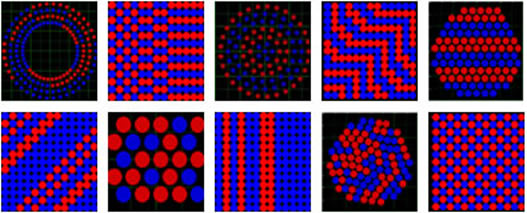
Polymagnets comprise patterns of magnetic elements (maxels) each with an assigned polarity (north or south shown in red and blue). Patterns with variations in maxel number, size, shape and amplitude are nearly limitless. Multiply that number by variations in material grade, surface geometry, and even dipole orientation and the possible combinations reach toward infinity.
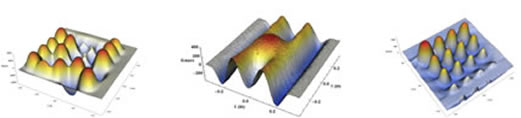
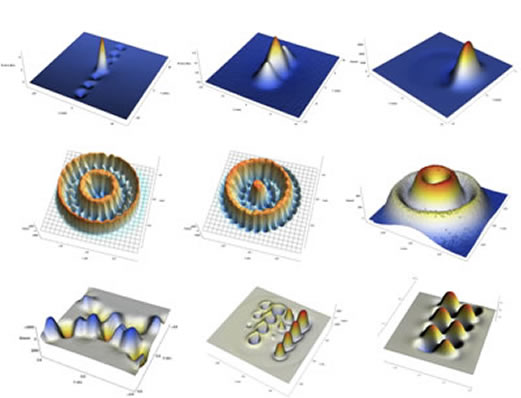
At right are field scans and spatial force functions illustrating the broad variety of functional codes developed at the CMR labs during the initial research & development following Larry Fullerton’s discovery and invention in 2008.
Variable Parameters for Coded Magnets
Maxel pattern
Maxel size, shape
Polarity
Polarity balance
Amplitude
Code density
Dipole orientation
Material grade
Material composition
Surface geometry
1D, 2D, 3D patterns
Electromagnet array (time)
Each unique combination of parameters results in a unique magnetic field. Interaction among customized magnetic fields determine the behavior of correlated magnetic device.
Shown at right are examples of the wide variety of shapes the coded magnetic fields can assume. As the number of maxels in any pattern increase, so does the complexity of magnetic field geometric features.
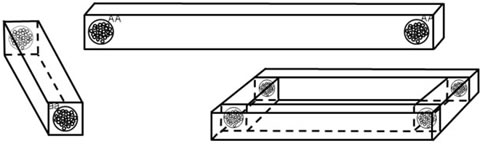
Unique magnetic patterns can provide strong magnetic attachment and discriminate among other coded magnets, giving rise to “assembly intelligence” where components can be mated as the designer or engineer intended and at the proper spatial orientation.
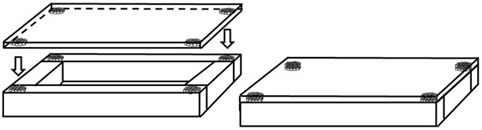
Shown at right is a notional diagram depicting table or panel components featuring coded magnet connectors. The components will mate in the proper orientation and only with the coded counterpart of the connector.
This ability to discriminate enables savings in assembly and/or installation time, as well as potential reduction in size and weight of construction material by reducing “overdesign” compensation for alignment errors in assembly and integration.
Component assembly in modular furniture, pre-fab building construction, tools, toys, tables, and more can benefit directly from correlated magnetics.
CMR’s patented correlated magnetics technology can be implemented using arrays of conventional magnets, by employing CMR’s proprietary MagPrinter circuit, or even via arrays of electromagnet elements.